 REMOTE DESKTOPS
Windows in every room
Use tiny clients behind monitors to open Windows or Linux virtual desktops hosted on a central server. Planned capability; compatible hardware and licensing required.
See how it works ↗Access a Windows desktop from small clients in different rooms, run your own media library and smart-home services, and put hardware you already own to work. These are goals for the platform, not claims that every feature is ready today.
Your main SamyStackOS server would host a Windows virtual machine. A lightweight thin client at another desk would connect to it over your home network, so the screen, keyboard and mouse behave like a normal PC while the main computer does the heavy lifting.
Picture an office desk, a homework station and a workshop screen—all connected to central computing resources, with compatible clients chosen for each location. Access to separate or simultaneous Windows sessions requires suitable operating-system licensing and configuration.

Use cases are goals for compatible hardware and applications, not a guarantee that every feature is implemented today.
REMOTE DESKTOPSUse tiny clients behind monitors to open Windows or Linux virtual desktops hosted on a central server. Planned capability; compatible hardware and licensing required.
See how it works ↗ MEDIA
Host a local movie or music server, access collections across your devices and schedule supporting services.
 SMART HOME
Run a supported automation server and connect ESP32 sensors, buttons and relay controls.
 DEVELOPMENT
Run Linux VMs, containerized applications, staging services and isolated experiments on compatible hosts.
Divide compatible photo, file and batch-processing jobs among Android workers and other eligible devices.
Explore topic ↗Host DNS, service monitoring, gateways, local dashboards and dedicated network-management services.
 STORAGE
Pool appropriate storage resources, serve shared files and plan versioned backup and recovery workflows.
 CAMERA SYSTEMS
Use compatible cameras and edge gateways with a storage-backed local video service.
Use a Raspberry Pi or supported embedded endpoint for a radio player, local control panel or distributed audio service.
Build device-specific integrations that connect sensors and controls to a central service safely.
A management console should make it easy to see which node runs a service, what resources it uses and how to restore it.
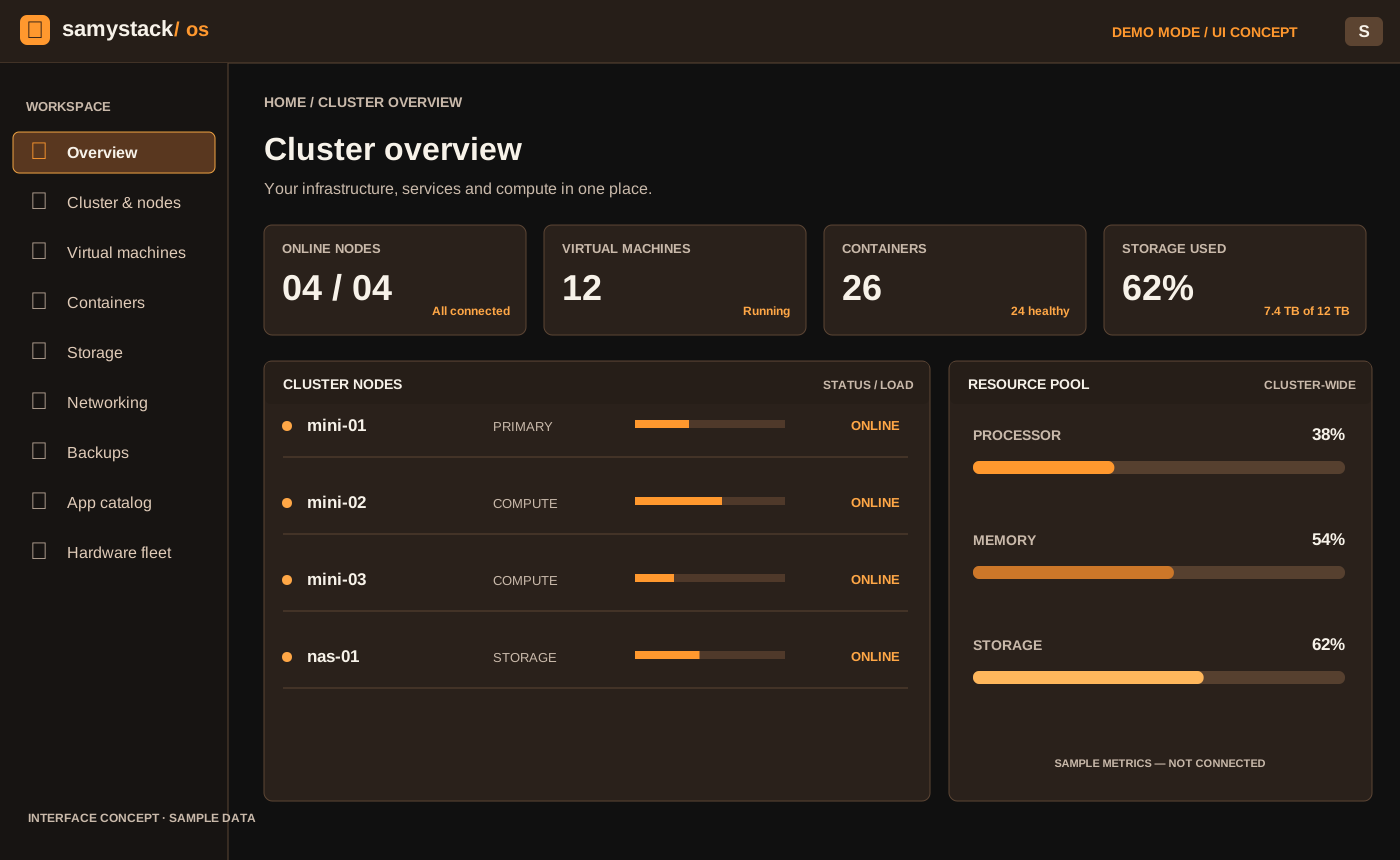
Explore the interface through a separate full-window interactive preview.